
Every Bearing Heard Through the Steam. The Machine Keeps Making Paper.
Continuous Condition Monitoring for the Assets That Stop a Mill.

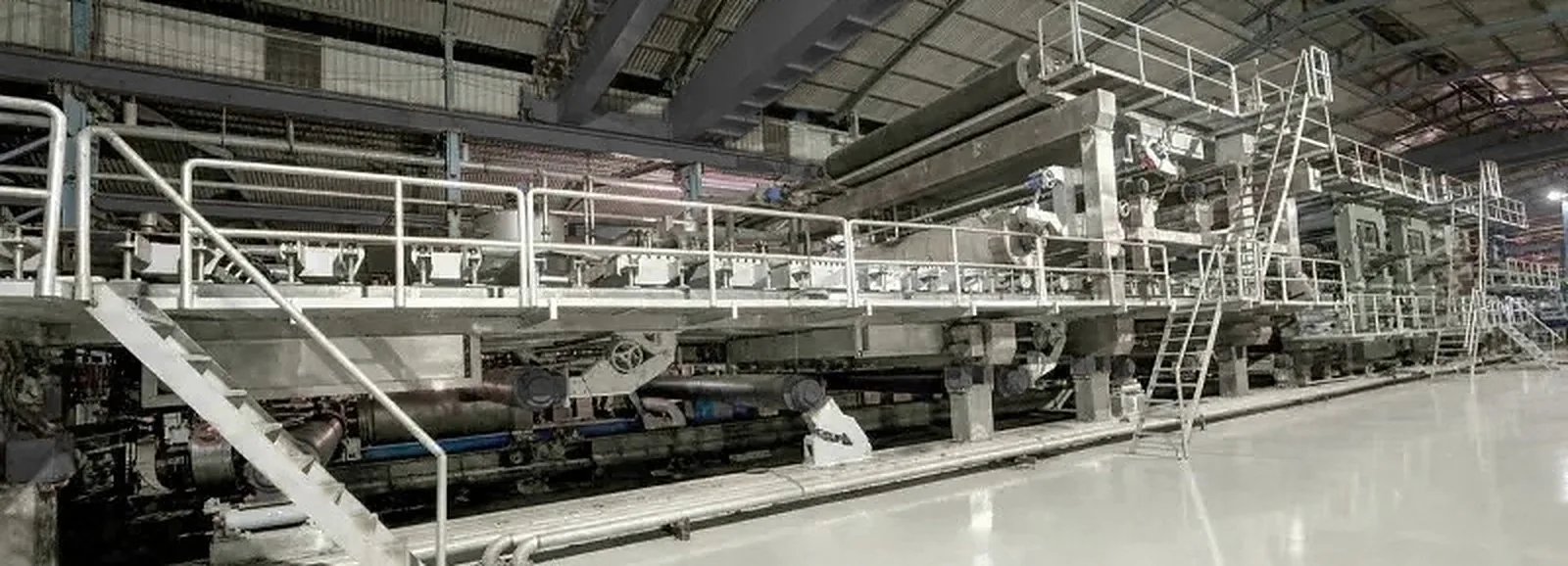
Predictive Maintenance for Pulp & Paper Mills
Every roll, bearing and dryer — monitored in real time.
Continuous Condition Monitoring for the Assets That Stop a Mill.
Predictive maintenance for pulp and paper mills is continuous condition monitoring of the assets that keep fiber moving and the paper machine running — chip conveyors, wet-end rolls, stock pumps, dryer fans and steam traps — so a developing fault is corrected on a planned schedule instead of breaking the run. Coverage spans the pulp mill and the paper machine alike — debarker and chipper drives, log conveyors, pulpers, agitators, process and vacuum pumps, press section and calender rolls, and the motors and gearboxes behind them. It combines ultrasound, vibration, temperature, electrical and steam-system monitoring with validated analysis and autonomous lubrication.
Mills are among the hardest monitoring environments in industry: moisture, heat, dust and continuous duty break grease down and hide early fault signals from manual rounds. On one pulp and paper chip conveyor, the closed-loop reliability ecosystem's monitoring and autonomous lubrication extended bearing life 30–50%, eliminated lubrication-related failures entirely, and returns more than $20,000 a year.
UltraVibe™ captures ultrasound, HFE, vibration and temperature at every critical bearing. MatrixHub™ learns each asset's baseline and ranks every deviation by production risk. Industrial Matrix reliability experts validate each finding before it reaches your work queue, and AI LubeMatrix™ performs online condition-based lubrication — ultrasonic greasing — on the bearings manual routes reach least. From the first ultrasonic signal to verified corrective action, the loop closes inside your mill.
Precision at the Core
01
Steam, washwater, pulp dust and continuous duty strip lubricant faster than any calendar schedule assumes. Bearings starve between rounds — and lubrication breakdown is one of the leading causes of premature bearing failure.
02
Chip, log and residual conveyors run long, exposed and half-forgotten. One seized bearing stops the fiber feed, and the noise of a running mill hides the warning signs from human ears until it is too late.
03
Elevated conveyor bearings, dryer-section fans and guarded drives are the points a route skips on a short shift. AI LubeMatrix™ doses them on their measured ultrasonic friction signature, then verifies friction returns to baseline.
04
An unplanned stop on a paper machine costs the whole run. Every validated finding becomes a prioritized work order, reviewed in our biweekly Customer Success meeting and scheduled into your next planned washdown or shutdown.
$20K+/yr
returned by closed-loop monitoring and lubrication on one chip conveyor
30–50%
longer bearing life on monitored, condition-lubricated conveyor bearings
~$30K
avoided per event — wet-end bearing faults caught in time for planned washdowns
Failure Mode | Signature We Detect | Consequence If Missed |
|---|---|---|
Conveyor bearing lubrication breakdown | Rising ultrasonic friction signature — at the earliest stage, before vibration changes | Bearing seizure, fiber feed stops, unplanned machine outage |
Wet-end roll bearing faults — couch and press rolls | Early bearing-defect vibration and a rising temperature trend, flagged early enough to schedule the repair into a planned washdown | Unplanned paper machine stop and paper quality defects — wet-end downtime documented at $5,000+ per hour |
Bearing race defects on pumps and fans | HFE bearing-defect frequencies, then broadband vibration | Unplanned replacement, secondary shaft and housing damage |
Imbalance and misalignment on dryer and process fans | Elevated vibration at running speed | Accelerated wear, coupling and structural damage |
Gearbox wear on conveyor and agitator drives | Gear-mesh sidebands and rising HFE energy | Long-lead gearbox replacement, extended outage |
Motor electrical faults | Current imbalance and overload drift (PULSE Series™) | Motor trip mid-run, winding damage |
Steam trap failure across the dryer section | Constant ultrasound (failed open) or silence (failed closed) | Wasted steam, poor drying, condensate damage — $8,000–$12,000 a year per failed-open trap |
Sense → Analyze → Validate → Act
01
UltraVibe™ 4-in-1 sensors on conveyors, pumps and mill-critical drives capture ultrasound, HFE, vibration and temperature at the bearing — through steam, moisture, dust and continuous duty.
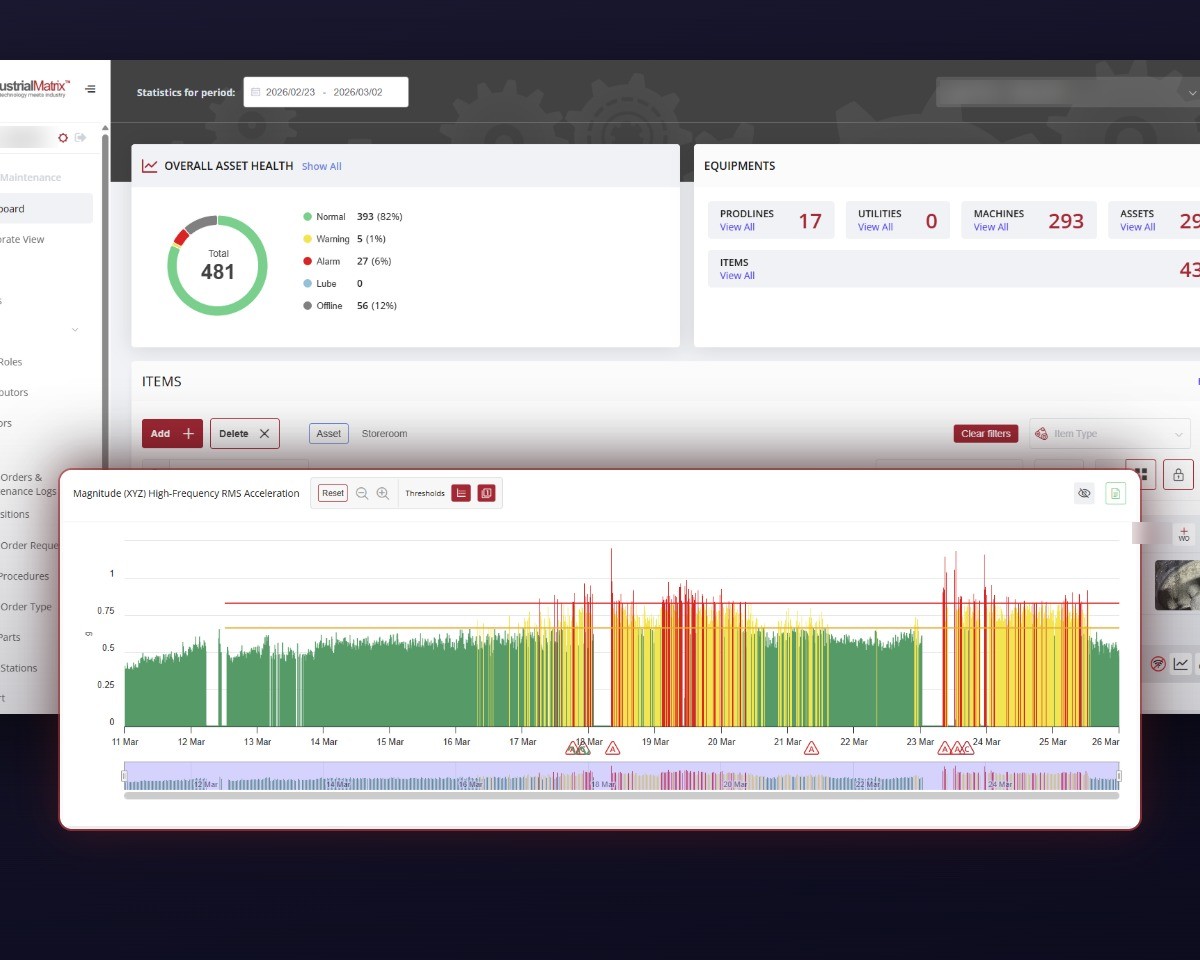
02
MatrixHub™ learns each asset's normal operating signature and ranks every deviation by what it would stop — the chip conveyor above the utility fan.
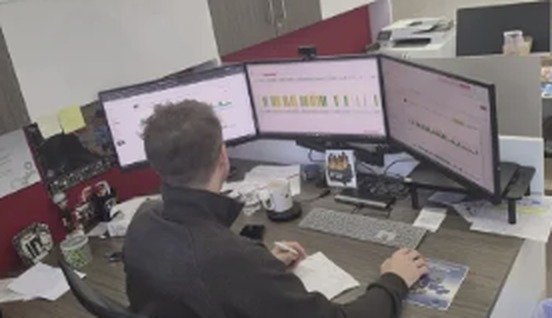
03
Our Customer Success team validates every flagged anomaly before it reaches you, so no false alarm lands in your work queue.
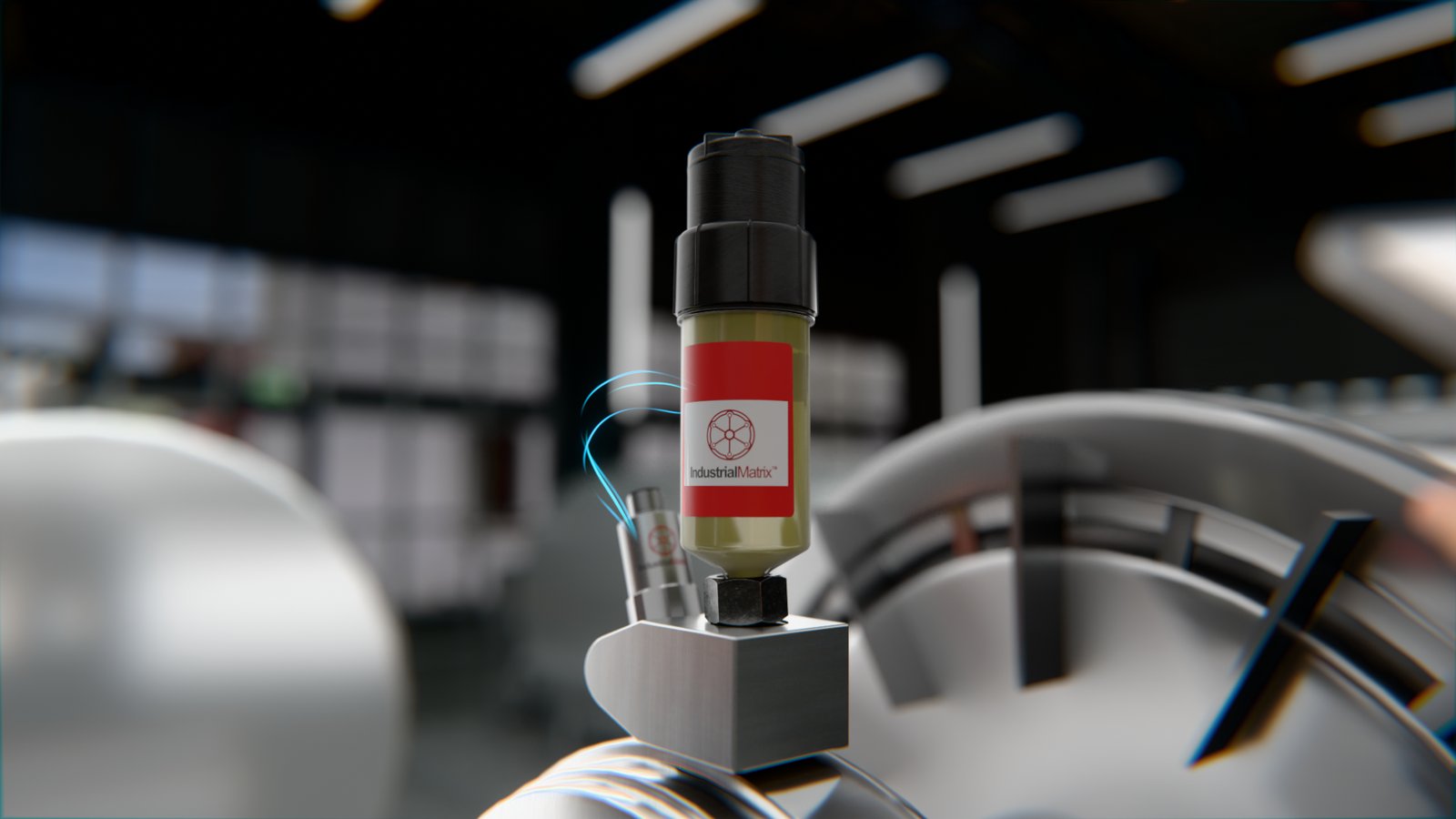
04
Lubrication faults are corrected autonomously by AI LubeMatrix™ on live ultrasound. Every other confirmed fault becomes a prioritized work order, reviewed in our biweekly CS meeting and tracked until solved.
Every mill gets its own coverage plan from a site survey: the conveyors and machine-critical drives get full 4-in-1 UltraVibe™ monitoring, the supporting equipment across the rest of the mill gets VELO™ Series vibration and temperature sensors, and steam traps are covered by SteamMatrix™.
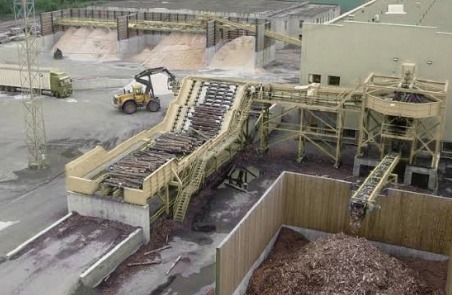
The woodyard and stock-prep conveyors, debarker and chipper drives that feed the entire mill — long, exposed, continuously loaded, and the proven home of closed-loop autonomous lubrication.
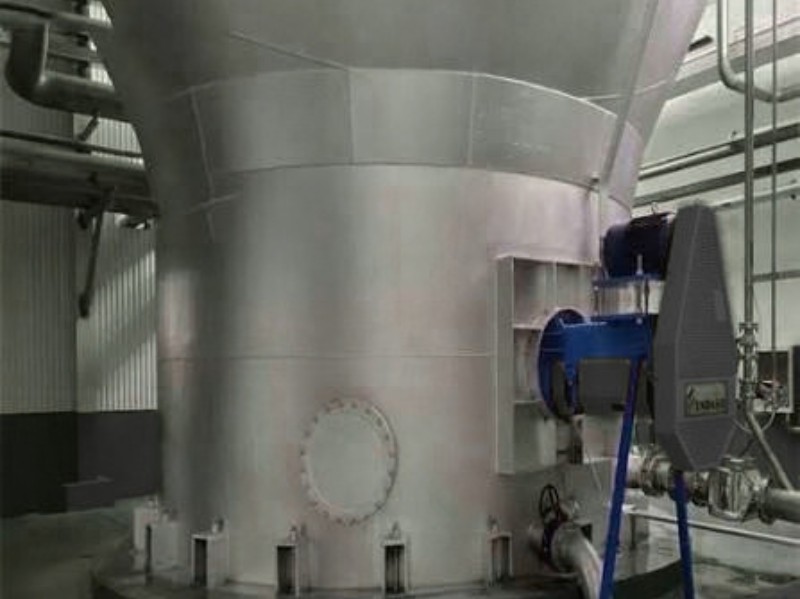
Stock and fan pumps, agitator drives and gearboxes, and the vacuum pumps behind the wire — the continuous-duty drives that move stock from pulping to the headbox.
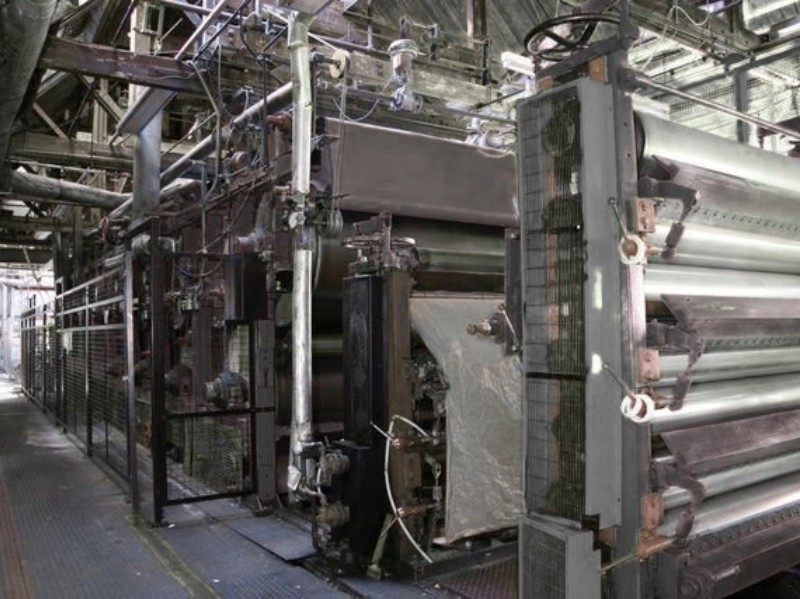
Supply and exhaust fans, dryer drives and the steam traps across the dryer section — where mechanical health and steam efficiency decide drying capacity.
Recommended configuration for a pulp and paper mill. Final coverage is set per asset during the site survey.
Mill-critical rotating assets | UltraVibe™ 4-in-1 — ultrasound, HFE, vibration, temperature. Wired (M12, Modbus RTU over RS-485, 24 V DC), IP69K/IP67, −40 °C to +105 °C |
|---|---|
Broad mill coverage | VELO™ Series temperature and vibration monitoring — VeloSense™ wireless (5+ year battery), VeloLink™ wired IP67 for tight mounts, VeloShield™ IP69K stainless for washdown areas. −40 °C to +150 °C |
Hard-to-reach bearings | AI LubeMatrix™ — online condition-based lubrication triggered by the ultrasonic friction signature. NLGI 1–3, 24 V DC, IP66 / NEMA 4X |
Electrical | PULSE Series™ — current, infrared, airborne ultrasound and cabinet climate on motors, drives and MCCs |
Steam | SteamMatrix™ — contact ultrasound on every critical trap across the dryer section and steam distribution |
Analytics & integration | MatrixHub™ — per-asset baselines, thresholds in 24–48 hours, Modbus, MQTT, OPC-UA and REST into your CMMS |
Predictive maintenance for pulp and paper mills is the continuous monitoring of the assets that keep fiber moving and the paper machine running — chip conveyors, stock pumps, agitators, wet-end rolls, dryer fans, drives and steam traps — using ultrasound, vibration, temperature and electrical data. A developing fault is caught at its earliest stage and corrected on a planned schedule instead of breaking the run.
In one published wet-end case, unplanned downtime was documented at $5,000 or more per hour, and each early bearing catch on couch and press rolls avoided approximately $30,000 per event by moving the repair into a planned washdown. Paper machine downtime cost varies by mill, grade and machine speed, and is usually measured per hour of lost production.
Most unplanned downtime in a mill starts with a rotating asset on or feeding the paper machine: wet-end and press section roll bearings, dryer-section bearings and failed steam traps, vacuum pump and stock pump failures, and woodyard chip conveyor, debarker and chipper drives that starve the digester. Lubrication is a common root cause — in the published chip conveyor case, lubrication-related failures stopped entirely once greasing ran on measured friction.
Conveyor bearings in mills fail mostly for lubrication reasons. Moisture, heat, pulp dust and continuous duty strip grease faster than calendar schedules assume, the bearing starves, friction rises, and the bearing seizes — lubrication breakdown is one of the leading causes of premature bearing failure. The bearings are also numerous, elevated and spread across the woodyard, so manual greasing rounds miss exactly the points that need attention most.
Two published mill cases show the range. On a chip conveyor feeding the digester, closed-loop monitoring with autonomous lubrication extended bearing life 30–50%, eliminated lubrication-related failures entirely, and returns more than $20,000 a year. On a paper machine wet end, continuous vibration and temperature monitoring caught multiple early-stage bearing faults on couch and press rolls in time to schedule each repair into a planned washdown, avoiding approximately $30,000 per event.
A mill should monitor first the assets whose failure stops fiber flow or breaks the run and that have no installed spare: chip and log conveyors, couch and press roll bearings, stock and fan pumps, agitators, dryer-section supply and exhaust fans, vacuum pumps, and the gearboxes and motors behind them. Steam traps across the dryer section follow immediately — a single failed-open trap wastes $8,000–$12,000 a year.
Every section of a paper machine carries rotating assets that can stop the run. In the wet end and press section: the fan pump feeding the headbox, couch, press and suction roll bearings, and vacuum pumps. In the dryer section: dryer cylinder and felt roll bearings, supply and exhaust fans, and the steam traps that control drying. At the dry end: calender, reel and winder drives — and on tissue machines, the Yankee dryer drive and its bearings. Upstream, stock prep pumps, agitators and refiner drives, and the conveyors feeding the digester, complete the critical list.
Paper drying runs on steam, and in an unmonitored system roughly 30% of traps have typically failed. A failed-open trap blows live steam to condensate — $8,000–$12,000 a year, per trap — while failed-closed traps flood dryer cans and hurt drying capacity. SteamMatrix™ mounts contact ultrasound on every critical trap and flags failures the day they develop, converting an annual survey into continuous knowledge.
Ultrasonic greasing is online condition-based lubrication driven by the bearing's ultrasonic friction signature instead of a calendar. AI LubeMatrix™ performs it autonomously: it reads live online ultrasound, dispenses grease only when friction shows the bearing needs it, at the dose it needs, then confirms friction returns to baseline. It is triggered by ultrasound alone — never by temperature or vibration — and it is proven on mill chip conveyors, where it eliminated lubrication-related failures entirely.
Yes, provided the sensors are sealed for wet-end spray and washdown. UltraVibe™ is sealed to IP69K/IP67 and operates from −40 °C to +105 °C; VeloShield™ adds an IP69K stainless-steel, chemically resistant option for washdown zones, and VeloSense™ covers hard-to-cable areas wirelessly on a 5+ year battery. Environmental survivability is the first qualifying question for any mill monitoring program.
No. MatrixHub™ performs the analysis and the Industrial Matrix Customer Success team validates every finding with your team on a fixed biweekly cadence. Wet-end roll, dryer-section and conveyor findings arrive already interpreted, with the corrective action defined and timed to your next planned washdown or shutdown.
Predictive maintenance in a mill identifies that an asset — a couch roll bearing, a chip conveyor, a dryer fan — is degrading before it fails. Prescriptive maintenance goes further and specifies, or executes, the fix: predictive tells you a chip conveyor bearing is starving; prescriptive greases it. Industrial Matrix delivers both — validated findings become work orders timed to planned washdowns, and AI LubeMatrix™ executes lubrication corrections autonomously.
A mill should look for sensing that covers the whole failure curve — ultrasound and HFE, not vibration alone; hardware rated for moisture, heat and dust; steam system coverage, because drying capacity is production capacity; human validation so false alarms never reach the work queue; and a path from alert to executed correction. Several vendors now combine vibration and ultrasound sensing. Industrial Matrix is the only company that combines a full condition monitoring sensor ecosystem with an autonomous condition-based lubrication actuator in one closed loop.
Sensors mount externally on bearing housings while the machine keeps running, and MatrixHub™ sets each asset's alarm thresholds autonomously within 24 to 48 hours. Most mills start on the woodyard conveyors and the wet end, then extend to the dryer section and steam traps — with no baseline study and no machine-by-machine manual tuning.
Our Vision
A mill where no bearing fails by surprise and no trap bleeds steam unseen. Every conveyor heard through the noise, every lubrication fault corrected on measured friction, every finding validated and closed — the foundation of machine self-healing, one standard across every mill.