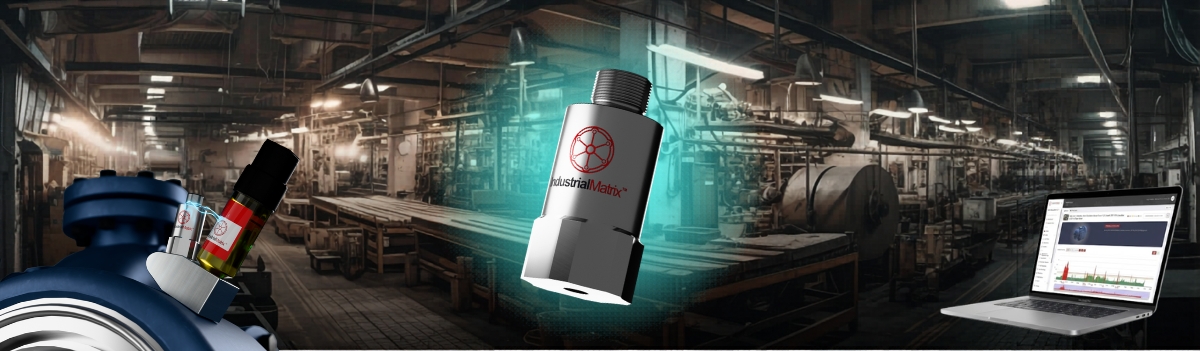
The UltraVibe™

Four Signals. One Sensor. Zero Blind Spots.

Ultrasound. High Frequency Enveloping. Vibration. Temperature. One Ruggedized Industrial Sensor.

UltraVibe™ moves industrial condition monitoring beyond detection and into execution - fusing ultrasound, high frequency enveloping, vibration velocity, peak acceleration, and temperature into a single ruggedized industrial sensor that delivers deterministic asset health intelligence across the entire P-F curve, detecting lubrication deficiency, bearing friction, mechanical imbalance, misalignment, and thermal anomalies weeks before functional failure develops, feeding every live signal directly into MatrixHub™ where adaptive machine learning analytics generate validated prescriptive maintenance recommendations in real time, and correlating directly with AI LubeMatrix™ to execute condition-based autonomous lubrication at the precise dosage asset conditions demand - no human intervention, no scheduled guesswork, no lubrication failure - from the earliest ultrasound signal to autonomous corrective execution, UltraVibe™ closes the loop.

Our Purpose

From Reactive Noise to Deterministic Asset Intelligence
Traditional sensors force a choice. UltraVibe™ forces none. Ultrasound and high frequency enveloping detect lubrication deficiency and microscopic bearing fatigue weeks before mechanical damage develops - delivering the earliest predictive maintenance warning available in industrial condition monitoring. Vibration velocity and peak acceleration identify imbalance, misalignment, and structural looseness with precision - the foundation of every effective PdM program. Temperature intelligence tracks thermal anomalies and lubrication breakdown continuously. Four technologies. One ruggedized industrial condition monitoring sensor. Complete P-F curve coverage - from the earliest acoustic warning to advanced mechanical fault protection - with every signal feeding live into MatrixHub™ and AI LubeMatrix™ to close the loop from predictive maintenance detection to prescriptive autonomous corrective action.

Precision at the Core

4-in-1 Multi-Modal Fusion

A unified sensing architecture that simultaneously monitors Vibration (Velocity RMS), Ultrasound (HFE), Shock (Peak Acceleration), and Temperature.

Edge-Native Intelligence

Features an onboard computing engine that automates baseline establishment. The sensor distinguishes between "Running" and "Stopped" states to build valid statistical profiles without human intervention.

Bimodal Fault Logic

Proprietary algorithms differentiate between Acute Faults (instantaneous jams or fractures) and Chronic Faults (long-term wear), drastically reducing false positives.

Seamless Integration

Encased in 316 Stainless Steel enriched with molybdenum for superior chloride corrosion resistance. The housing is IP69K rated, engineered to withstand caustic washdowns, high-pressure sanitation, and extreme thermal cycling (-40°C to +105°C).

Rugged Industrial Design

Built for the connected factory. Operates via Modbus RTU (RS-485) for seamless integration with PLCs, SCADA, and the AI Suite™.

Airborne and Structure-Borne
Ultrasound Sensing

Dual-Domain Intelligence: Macro-Structural & Micro-Surface

The ULTRA VIBE™ does not just listen; it interrogates the machine
structure through two distinct physical domains.

1. The Micro-Structural Domain (HFE & Ultrasound)

Before a bearing fails, it emits ultrasonic energy. The ULTRA VIBE™ utilizes High Frequency Energy (HFE) processing-enveloping and demodulation-to isolate impact bursts in the 1 kHz to 20 kHz range. This allows for the detection of:

  • Microscopic pitting and spalling.

  • Lubrication film breakdown.

  • Pump cavitation and flow turbulence.

2. The Macro-Structural Domain (Vibration Velocity)

To protect the asset's structural integrity, the sensor monitors Velocity RMS (10 Hz – 1000 Hz). This captures low-frequency, high-energy faults including:

  • Rotational unbalance and misalignment.

  • Mechanical looseness.

  • Late-stage structural fatigue.

Built for Reliability

Autonomous Self-Calibration

The sensor utilizes statistical profiling (Mean + Standard Deviation) to automatically set warning and alarm thresholds specific to the machine’s mounting stiffness and load.

Hygienic & Rugged Design

The low-profile, non-threaded 316SS barrel minimizes bacterial harboring and resists chloride corrosion, making it ideal for food, beverage, and pharmaceutical environments.

Data-Rich Diagnostics

Beyond simple alarms, the sensor provides advanced statistical metrics-Crest Factor and Kurtosis-to characterize the "spikiness" of the signal, helping engineers distinguish between random noise and periodic defect impacts.

How It Works

Capture

The piezoelectric and MEMS elements continuously capture multi-axis energy (X and Z planes) and surface temperature.

Analyze

The edge processor applies band-pass filtering and rectification to extract High Frequency Energy (HFE) envelopes from the raw waveform.

Alert

Onboard logic compares real-time inputs against the auto-generated baseline, calculating statistical deviations (Kurtosis, Crest Factor).

Communicate

Data is mapped to 16-bit Modbus holding registers. Acute (shock) and Chronic (wear) bitmasks are transmitted to the control system or AI Suite™.

Verify

Maintenance teams receive precise recommendations: "Lubricate" (HFE warning), "Align" (Velocity warning), or "Stop" (Acute Shock alarm).

Engineered Differentiation -

What Sets ULTRA VIBE™ Apart

The "Jam" vs. "Wear" Distinction

Most sensors see a spike and trigger an alarm. The ULTRA VIBE™ uses intelligent windowing to distinguish between a transient mechanical shock (Acute) and progressive degradation (Chronic).

Retrofit Readiness

Designed with a dual-mounting interface. It features a primary M12 stud for new, high-frequency installations and a secondary 1/4-28 UNF thread to retrofit onto existing accelerometer mounts without re-drilling.

Spectral Authority

By monitoring HFE Kurtosis and Peak Acceleration, the sensor enables "condition-based lubrication," preventing both under-greasing (friction) and over-greasing (seal damage).

Technical Specifications

Capability

Specification

Sensing Architecture

4-in-1: Vibration (Velocity), Ultrasound (HFE), Shock (Peak G), Temperature

Frequency Response

Velocity: 10 Hz – 1000 Hz
HFE/Ultrasound: 1 kHz – 20 kHz (Demodulated)

Measurement

Velocity: 0 – 50 mm/s
Acceleration: ±50 g Peak

Housing Material

316 Stainless Steel (Molybdenum-enriched for corrosion resistance)

Ingress Protection

IP69K (High-pressure/High-temp washdown) & IP67 (Submersible)

Temperature Range

Sensing Element: -40°C to +105°C
Electronics: -40°C to +80°C

Communication

Modbus RTU (RS-485) over M12 QD Connector

Mounting

M12 x 1.75 Integrated Stud (Primary)
1/4-28 UNF Tapped Hole (Retrofit)

Edge Logic

Auto-Baselining (Mean + $\sigma$), Acute vs. Chronic Fault discrimination

Supply Voltage

24 V DC (Nominal)

Diagnostics

RMS, Peak, Crest Factor, Kurtosis, Temperature

Ideal Use Cases

Critical Rotating Assets

Motors, pumps, and fans where 24/7 visibility is required to prevent unplanned downtime.

Compressed Air & Gas Systems

Using HFE metrics to detect gear tooth cracking in low-RPM applications where standard velocity sensors are blind.

Steam and Pressure Lines

Food and beverage processing lines requiring frequent high-pressure caustic washdowns.

Hard-to-Reach Machinery

Assets located in hazardous or inaccessible areas, eliminating the safety risk of manual route collection.

FAQ

Our Vision

Industrial Matrix turns signal into strategy.

With the ULTRA VIBE™, we have moved beyond passive monitoring to active, edge-native intelligence. This is reliability that listens, thinks, and protects.

Hear the unheard.

Experience the intelligence
behind every signal.